Education in Guatemala’s rural indigenous communities begins with a problem most people don’t see.
In Guatemala, roughly one in two children under five suffers from chronic malnutrition. Guatemala ranks first in Latin America and sixth in the world for child malnutrition (ReliefWeb), and the burden is not evenly distributed. Among indigenous children, the rate of chronic malnutrition climbs to 61.2% (Unicef) In other words, more than three in five children from Mayan communities are growing up with a condition that shapes everything that follows.
This is the context that organizations like Casa Guatemala work within every single day.
Effects of chronic malnutrition
Malnutrition in Guatemala is commonly discussed in terms of “stunting” in children whose physical growth is measurably impaired. In addition, chronic malnutrition leads to poor cognition, increased risk of illness, and developmental problems that compound over a lifetime (ALDEA). A child cannot concentrate in school if they are hungry or ill. A child who falls behind is more likely to drop out and more likely to remain in poverty as an adult. Child born into poverty are more likely to be malnourished.
“It is a cycle of malnutrition,” as one medical coordinator working in Guatemala has put it. “Since we have mothers who were malnourished girls, who grow up as malnourished adolescents and are malnourished when pregnant, then malnourished boys and girls are born” (ReliefWeb).
This is what makes breaking the cycle so difficult. The problem is not a single intervention point. It is a web of interconnected conditions: food insecurity, limited healthcare access, poor sanitation, indoor air pollution from cooking fires, language barriers that make it difficult to access services, and centuries of economic and political exclusion of indigenous communities that have left entire regions structurally underserved.
The education piece
Access to education in Guatemala is profoundly unequal. O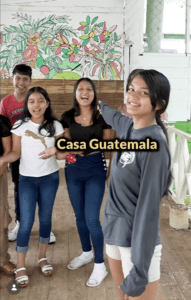 nly 30% of children finish elementary school. In rural and indigenous communities, that number is lower still. The reasons are multiple: schools are too far away, families need children to work, the cost of supplies is prohibitive, and instruction is often delivered in Spanish in communities where the primary language is one of Guatemala’s 24 Mayan languages.
For many rural families, access to a quality education is not a question of choice or priority. It is simply a question of geography and resources. The school either exists within reach or it doesn’t.
In communities surrounding Lake Atitlán, studies have found that 65.6% of children under five are stunted and likely malnourished (PubMed), a figure that reflects food scarcity. Education and nutrition are inseparable. A school that also feeds children, tends to their health, and trains families in sustainable agriculture is addressing what the problem actually requires.
Why an integrated model matters
The organizations making meaningful progress in rural Guatemala tend to share a common characteristic: they don’t try to solve one problem in isolation. They work on nutrition and education together. They address health alongside food security. They build enterprises that create employment for the people they serve.
This is the model that Casa Guatemala has built in Rio Dulce over nearly five decades. It’s a K-6 school alongside a medical clinic, a working farm, a nutrition program, and social enterprises that employ graduates. It is a community that has constructed its own infrastructure for survival and flourishing, in a region that the government and international NGOs often overlook.
Children who are fed learn better. Children who learn stay in school longer. Young people who finish school have more options. Communities with more options have lower poverty rates and thus produce healthier children.
The cycle can run in the other direction. It just needs the right conditions and the people willing to build them.
Why this matters for groups Somos works with
When students and educators travel with Somos to visit partner organizations in Guatemala, they are arriving to witness the people who are actively dismantling the cycle of poverty.
Guatemala’s malnutrition and education crisis is severe. It is also not inevitable. Indigenous communities have been dealing with it for generations, and they are finding ways through with outside support. Somos connects groups to the people doing that work, so their effort can be part of something real.
Interested in bringing a group to learn from the organizations working on these issues in Guatemala? Somos Impact Travel runs partnership-based learning expeditions across Guatemala, Belize, and Peru, connecting schools, corporate groups, Rotary clubs, and other donor groups with local NGO leaders. Visit somos.travel/experiences to explore programs or start planning your group’s expedition.